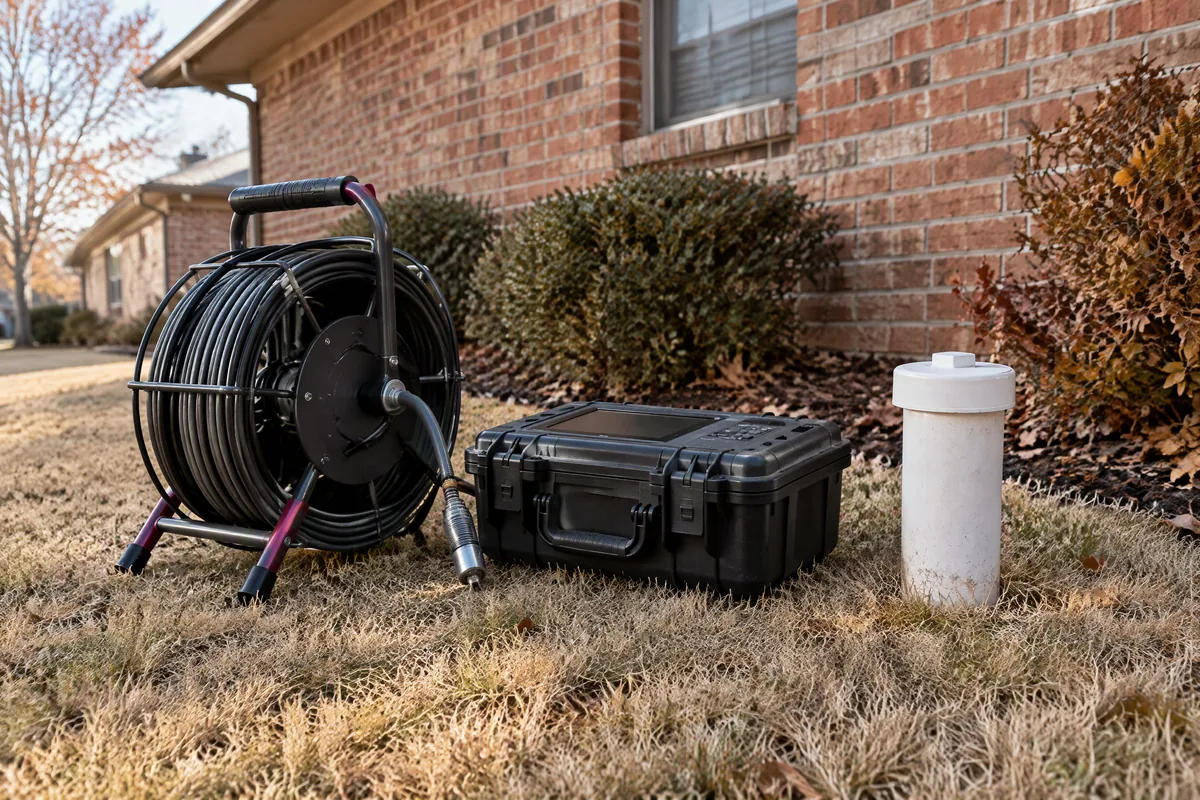
Before a sewer scope appointment at a Yukon home, ask one practical question: where can the camera enter the main drain line? A cleanout hidden behind stored items or beneath landscaping can change what is possible that day. Identifying it beforehand helps the inspector plan access and explain any limits without treating an unviewed section as satisfactory.
Locate the cleanout without opening it
A cleanout is a capped access fitting connected to the drainage piping. It may be visible outside near the home, but its location and appearance vary. Do not assume every white cap in the yard serves the sewer line; other systems can have similar-looking covers.
Ask the owner for the known location and any plumbing records showing previous access or work. If the owner does not know, share that uncertainty when booking rather than promising that a usable opening exists. Redbud Property Inspections' Drain / Sewer Scope Inspections examine accessible portions of the main drain line from an available access point, not every concealed branch serving the house.
Send a location photo, not just a close-up
A photograph showing the cap beside the wall, walkway, or fence is more useful than an isolated picture of plastic. Include a closer view if practical. Leave the cap closed; the inspector needs to assess whether the fitting is suitable and can be opened without damage.
Make the approach reachable
With the owner's permission, arrange to move ordinary loose items that block the route or working space. A visible cap can still be difficult to use if a parked vehicle, stacked storage, or locked gate prevents the inspector from positioning equipment nearby.
For a Yukon property with a side-yard cleanout, confirm how that gate will be unlocked before the appointment. Tell the inspector about pets and any restricted areas. Do not dig for an uncertain fitting, dismantle landscaping, or try to loosen a stuck cap yourself. Report those conditions in advance so access arrangements can be discussed.
Clear access does more than help a camera enter a pipe. Recording the opening and surrounding area connects the inspection footage to an identifiable starting point. InterNACHI's sewer-scope guidance recommends documenting the cleanout and equipment setup before inserting the camera.
When reviewing the results, ask which direction was inspected, what endpoint was reached, and what prevented further viewing, if anything. A distance shown on camera footage needs that starting-point context. It should not be read as a surveyed underground location or proof that all piping was examined.
Our article on why buyers add a sewer scope explains the broader purpose. Access preparation addresses a narrower question: what can this appointment actually document?
If access or camera travel is blocked
A buried, damaged, or immovable cap may prevent entry. Even after successful entry, pipe configuration, buildup, or an obstruction can restrict camera travel or visibility. Those are different limitations, and the report should distinguish them rather than simply label the whole line “good” or “bad.”
SeeSnake's manufacturer guidance cautions that obstructions can damage a camera or prevent its retrieval, and that a camera should not be used to clear them. Stopping can therefore be appropriate, not evidence that the unseen section is acceptable.
Ask what was observed and what remains unknown. If suitable access requires plumbing work, discuss arrangements with the owner and an appropriate plumbing contractor. Do not assume excavation, cap repair, drain cleaning, or toilet removal is included. Confirm any follow-up appointment and its scope after access has been addressed.
Match access preparation to the property's system
Confirm whether the property drains to a sewer connection or an onsite septic system. That information helps keep the appointment focused; a drain-line camera review does not become a tank or treatment-system inspection simply because wastewater reaches septic equipment.
For comparison, buried conventional septic lids in Guthrie raise separate access questions. With an aerobic system, alarm history and service records in Tuttle provide context that cleanout photographs cannot supply.
When arranging inspection services in Yukon, share the known cleanout location, access photographs, and any unresolved restrictions. Then schedule with Redbud Property Inspections so the planned inspection and available access can be discussed before the visit.